Measuring Impact in Entrepreneurship Education
A guide for Primary School Teachers (Ages 9–12 and 12 to 16+)
As a teacher, you are used to measuring what progress your students make. Impact-driven entrepreneurs are used to measuring what difference they make in society. In the IDEEC project, we bring this together. We present you a set of simple tools to measure what difference the project makes – for your students, yourself as a teacher and the community around you.
Download the Impact Guides
Impact Timeline
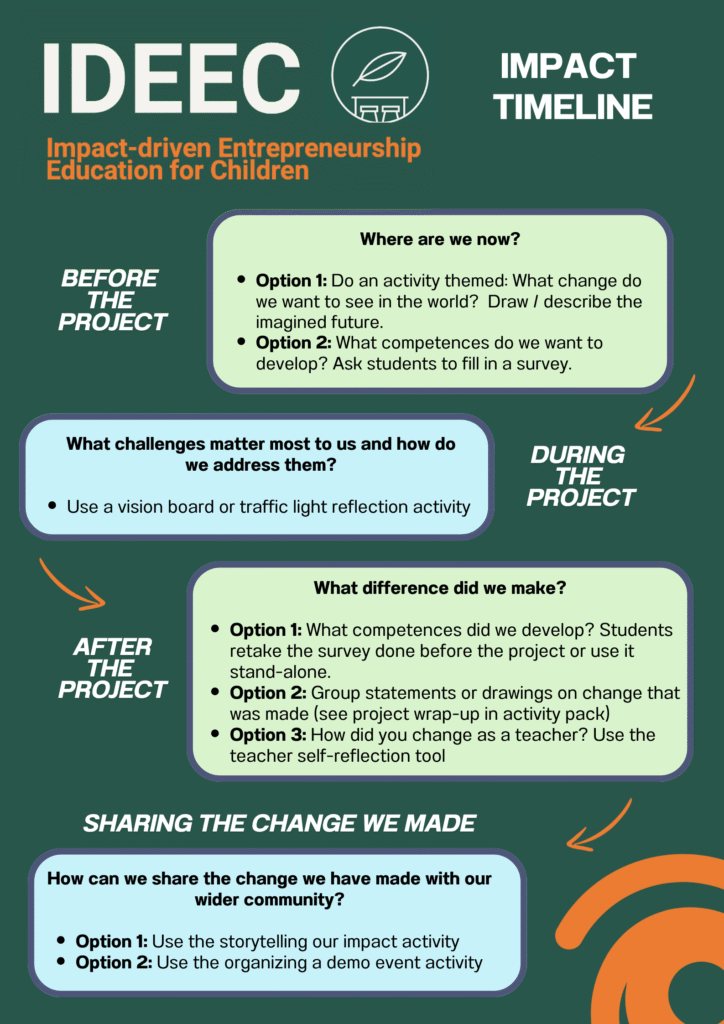
Impact Questionnaire
Here you find a list of questions for an impact questionnaire for students. You can adapt these to your needs.
Teacher Self-evaluation
Here you find a link to a self-evaluation questionnaire you can use as a teacher.
What does “Impact” Mean?
In simple terms, impact is the positive change your lesson creates in how students think, feel, or act. Think of your teaching like planting a seed – what new ideas or behaviors start growing? What excitement or pride blooms afterwards? For example, are students more excited about solving a problem or helping others after your activity?
How to Notice and Measure Impact
You’re likely already observing impact in small ways – kids’ eyes lighting up, energetic participation, or new questions they ask.
Here are child-friendly, “light-touch” tools you can use to capture those changes:
- “Two Likes and a Wish”: After a lesson, each student shares two things they liked or learned, and one thing they wish could be different next time. E.g.: “I liked learning about recycling. I liked working with my friend. I wish we had more time to build our project.”
- Smiley-Face Surveys: Use emojis or thumbs-up/down to ask if they had fun, learned something new, worked well in teams, or felt helpful.
- Quick Physical Check-ins: Try a playful prompt like “Put your hand on your head if you felt proud of yourself today!” Nearly all hands on heads means the lesson made them feel proud – and yes, even that is a sign of impact.
Why does Impact Matter?
At ages 9–12, children are forming their sense of self and how learning connects to the real world. Simple impact measures help them reflect on their growth and see learning as more than grades. For instance, asking what problem they tackled or who it helped, makes them connect schoolwork with real-life issues. This builds self-awareness and motivation, helps them feel part of something bigger, and shows that their ideas can make a difference beyond the classroom.
The Impact Driven Entrepreneurship Education project provides ready-made check-in ideas:
|
Stage |
Key Questions |
Tool / Activity |
Outcome |
|
Before |
Where are we now? |
Option 1 content: Class activity where you draw / describe the imagined future |
Establish baseline competencies and best imagined future as goals. |
|
Challenge |
What challenges matter most to us? |
Option 1: Draw the challenge chosen – in group(s) |
Identify and frame meaningful challenges. |
|
Solutions |
How can we address the challenge creatively? |
Option 1: Record students’ prototypes (and their reflections on it) |
Show what is developed and how this is done |
|
Impact Making |
What difference did we make? Did we also change (learn/grow)? |
Option 1: competence survey (linking to similar survey before project) |
Measure learning outcomes and societal impact |
|
Sharing the change we made |
How can we share the change we made with wider community? |
Option 1: Real world action log (online) |
Empower: sharing how to make a difference |
How to Measure change
The most reliable way to know if a difference has been made, is to use a before and after test – a pre and post survey. This allows you to track what has changed for your learners.
We have developed a simple, copiable impact survey can be found here. you can plug this into lessons, so measuring impact becomes a natural, easy part of your teaching process.
What about impact for me, the teacher?
It is also important to see your own change. This is why we have developed self-reflection tool for you the teacher here or here (this one downloads a copy for you to use).
We have developed a simple, copiable impact survey can be found here. you can plug this into lessons, so measuring impact becomes a natural, easy part of your teaching process.
Proudly powered by WordPress

Proudly developed by ideec.eu with support from EU funding.